The Hungarian SVD — FÉG HD-18
For roughly thirty years it was not possible to buy a new SVD-pattern rifle in the United States. The Chinese NDM-86 was shut out in the mid-1990s, the Russian Tigr followed shortly after, and sanctions since 2014 closed the Russian door permanently. Then a Hungarian company began shipping a milled-receiver Dragunov called the HD-18, and the drought ended.
This page covers what the rifle is, what is genuinely known about where it comes from, and what owners have actually found. Some of it is contested, and this page says so where that is the case. Specifications below are taken from FÉG's own service manuals where possible, in preference to retail copy.
Why it exists: the import drought
| Date | Event | Effect on SVD-pattern imports |
|---|---|---|
| 1993–94 | Chinese arms import ban | Ends the NDM-86, the main US source |
| 1996 | US–Russia Voluntary Restraint Agreement | Ends Russian commercial rifles, including the Tigr |
| 2014 | Sanctions following Crimea | Closes the Russian route further |
| 2022 | Sanctions following the full-scale invasion | Russian-origin firearms effectively blocked outright |
| 2023 | FÉG HD-18 announced at SHOT Show | Hungary is an EU and NATO member — no embargo applies |
That last row is the whole commercial logic. The rifle is not competing on price with a Russian SVD; there is no Russian SVD to compete with.
The provenance question
This is the contested part. FÉG markets the HD-18 as a return to production after fifty years, on the strength of Hungarian licensed manufacture of the SVD — the SzVD, in Hungarian transliteration. That claim is disputed by collectors, and the evidence for it is not public.
What is well established
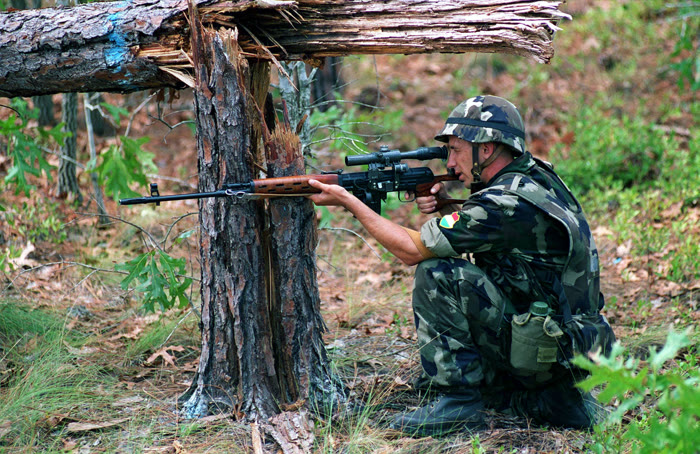
- Hungary was a Warsaw Pact member and the Hungarian People's Army fielded SVDs with PSO-1 optics. That much is not in doubt.
- Fielding a rifle and manufacturing it are different things. Warsaw Pact armies were routinely supplied with Soviet-made SVDs.
What FÉG is documented to have built
The original firm has a well-recorded catalogue, and it is worth laying out, because the SVD is conspicuously absent from it:
| Product | Type | Period |
|---|---|---|
| Frommer Stop | Pistol | Early 20th century |
| FÉG Model 58 / Tokagypt | Pistol | Late 1950s |
| AMD-65 | AK-pattern carbine | 1965–1980 |
| PA-63 | Pistol, Walther PP pattern | Cold War |
| AK-63 (AMM) | AKM-pattern rifle | 1977–2001 |
| P9M, P9RC, PJK-9HP | Browning Hi-Power derivatives | Cold War onward |
| AMP-69 | Rifle-grenade carbine | Cold War |
| Gas appliances, starting pistols | Civil production | Throughout |
Two things stand out. First, FÉG's military rifle work is Kalashnikov-pattern — a stamped-receiver tradition, not the milled short-stroke SVD. Second, even Hungary's best-known indigenous precision weapon, the Gepárd anti-materiel rifle, was not an FÉG product: it came from a separate design team at the end of the 1980s, with early assembly elsewhere.
This is not proof of a negative. A licensed line could exist without appearing in a summary catalogue. But it does mean the claimed SVD production would sit outside everything else FÉG is known for.
What is disputed
- Whether Hungary ever produced SVDs under licence. No documented production record has been put into public circulation.
- Collectors examining rifles previously presented as "Hungarian SVDs" report that they turn out to be Soviet or Russian rifles carrying the markings you would expect of Soviet or Russian rifles.
The company is also not quite the company
The original FÉG — founded in Budapest in 1891, and known over its life as Fémáru, Fegyver- és Gépgyár, then Lámpagyár, then Fegyver- és Gázkészülékgyár, then FÉGARMY — is not the entity building this rifle. The original firm came close to collapse in 2004 when its export markets were embargoed, and the surviving business today makes HVAC equipment rather than weapons.
The modern operation is a separate company that acquired FÉG assets, and by its own representatives' account is not affiliated with the original firm, though it claims to have obtained original tooling, blueprints and parts in the process. The manuals carry the names FÉG Fegyver és Gépgyártó Zrt. and FÉG Védelmi Rendszerek Zrt., both on Célgép Street in Budapest, rendered in the English documentation as FÉG Arms and Machine Company Limited.
How to hold this
None of the above makes the HD-18 a bad rifle, and none of it makes the company dishonest — acquiring tooling and reviving a product is ordinary industrial practice. But "heritage of licensed Hungarian production" is a marketing claim resting on evidence nobody outside the company has seen. It is now repeated verbatim in retailer listings, which is how a marketing line becomes received wisdom. Read it as a claim, not a finding.
If you have documentary evidence either way — Hungarian military records, factory documentation, a period rifle with Hungarian manufacturing marks — this site would very much like to see it. Please get in touch.
Manufacturer's specifications
From FÉG's HD-18 Technical Description and Service Manual, version 1.4 (2024). Where these differ from retail listings, the manual is the better authority — though FÉG itself notes that continuing development means the rifle and the manual may not always agree.
| Specification | Value |
|---|---|
| Designation | HD-18 |
| Type | Hungarian Dragunov-18 Sporting Rifle |
| Place of origin | Hungary |
| Manufacturer | FÉG Arms and Machine Company Limited |
| Mode of fire | Semi-automatic |
| Operating principle | Gas operated, rotating bolt |
| Cartridge | 7.62×54mmR |
| Weight, unloaded | 4.06 kg (8.95 lb) |
| Weight with PSzO-1M2 | 4.65 kg (10.25 lb) |
| Length | 123 cm (48.6 in) |
| Barrel length | 24.41 in (620 mm) |
| Rifling twist | 320 mm (1:12.6") |
| Effective firing range | ~1300 m |
| Maximum travel range | ~3800 m |
| Iron sight range | 100–1200 m |
| Optical sighting range | 1300 m with PSzO-1M2 |
| Rate of fire | ~30 rounds/min (practical) |
| Feed | Detachable stamped-steel box magazine, 10 rounds |
| Receiver | Milled |
| Barrel construction | Cold hammer forged, chrome lined; blanks sourced from Lothar Walther, finished by FÉG |
| Selector marking | "0 / 1" |
| Trigger | Around 3 lb as reported by reviewers |
The twist rate is the interesting number
This is the specification most worth understanding, and it is easy to skip past.
The HD-18 uses a 320 mm (1:12.6") twist. That is the original 1963 SVD rate — the one the rifle was designed around, and the one the Tigr kept — not the 240 mm (1:9.4") twist that Soviet military SVDs moved to in 1975.
As covered on the ammunition page, the 1975 change was a deliberate trade: a faster twist to stabilise tracer and armour-piercing loads, at a cost of roughly 19% precision with the 7N1 sniper round. The HD-18 sits on the pre-1975 side of that trade.
The practical consequences:
- It should favour lighter bullets, in the region of 148 grains, over heavy match projectiles.
- Against a late military SVD, it is theoretically the better barrel for precision work with an appropriate load — it gives up the stabilisation margin that only matters for ammunition types a civilian owner is unlikely to be shooting anyway.
- Anyone comparing HD-18 groups against a post-1975 SVD is, once again, comparing two different barrels rather than two different countries.
Accuracy in practice
Reported results cluster around 2 MOA with ordinary commercial ammunition. Reviewers working with better ammunition or handloads have reported figures nearer 1.5 MOA, with hits on man-sized steel reported out to around 650 yards. That is entirely in keeping with what the SVD pattern is: a designated marksman's rifle, not a bench gun. See the range reports for owner-supplied numbers on other rifles in the family.
The PSzO-1M2 optic
The rifle ships with a Hungarian-made 4× scope, factory matched to it. FÉG publishes a separate manual for the optic, and the numbers are worth putting next to the original.
| Specification | PSzO-1M2 (FÉG) | PSO-1 (Soviet) |
|---|---|---|
| Magnification | 4× | 4× |
| Objective aperture | 24 mm | 24 mm |
| Field of view | 6° | 6° |
| Eye relief | not less than 68 mm | ~68 mm (2.68 in) |
| Exit pupil | 6 mm | ~6 mm |
| Resolution | not more than 12 sec | 12 sec |
| Weight | not more than 0.6 kg (1.3 lb) | ~0.58 kg (1.28 lb) |
| Illumination | Red, 1.5 V AA cell | Red |
| Infrared detector | Deleted | Fitted on early examples |
Optically it is, within tolerance, the same instrument. The one substantive change is the removal of the infrared detector screen, which on the original was there to spot first-generation active infrared night-vision devices — a threat that stopped existing decades ago. Nothing of practical value is lost.
Everything that makes the PSO family distinctive is retained: the rangefinding stadia, the chevron bullet-drop reticle, and the elevation cam. The site's PSO-1 page covers how those are used, and the documents page carries the PSO zeroing manual.
Further detail from the optic manual:
- Overall dimensions 337 × 136 × 72 mm; reticle described as a 1,000 m pattern; windage in mils
- Nitrogen purged and waterproof; dark grey finish
- Closest focus 10 m; no independent focus adjustment
- Mount is a universal dovetail described as fitting both SzVD and AK/AKM side rails — so the optic is not locked to this rifle
- Supplied with mount bracket, rubber eyepiece, cleaning cloth, wrench, soft case, two batteries and a manual
What is in the box
Per the manual's delivery schedule:
- The rifle
- Two stamped-steel 10-round magazines
- Disassembly and cleaning accessory set
- Lubricating accessories and oiler
- Cleaning rod
- PSzO-1M2 optic set
- C.I.P. qualification reports
- Technical description and service manual
The accessory set follows Soviet practice closely: container body and cover that double as a wrench, bristle brush, scourer, screwdriver, drift, oiler, cheek pad, and a spare firing-pin spring set. The cheek pad is the detachable type fitted to the butt when the optic is in use.
Assemblies and parts nomenclature
FÉG divides the rifle into twelve main assemblies. Useful when ordering parts or reading the manual:
| ID | Assembly |
|---|---|
| 1 | Barrel with receiver |
| 2 | Rear sight leaf |
| 3 | Handguard retainer |
| 4 | Left handguard |
| 5 | Right handguard |
| 6 | Front sight base |
| 7 | Buttstock |
| 8 | Trigger mechanism |
| 9 | Safety lever |
| 10 | Bolt (head) with bolt carrier |
| 11 | Receiver cover with recoil mechanism |
| 12 | Magazine |
Note that assembly 3, the handguard retainer, is the single component most often named in owner complaints. See the quality-control section below.
Variants and configurations
| Configuration | Notes |
|---|---|
| Standard | Wood furniture, PSzO-1M2 optic, two magazines, threaded muzzle with flash hider |
| Blemished | Cosmetic seconds, sold at a discount by some distributors |
| California compliant | Featureless configuration; some sellers supply a compliance kit rather than a separate rifle |
Marketing at launch also referred to a collector-grade package alongside a plainer base model. In practice the distinction most buyers encounter is standard versus blemished.
Markings and identification
| Location | Marking |
|---|---|
| Receiver, left, above magazine well | FÉG logo |
| Receiver, left, behind the scope rail | QR code |
| Receiver, right, below ejection port | "HD-18 SPORTING RIFLE", "MADE IN HUNGARY", "Cal. 7.62x54R", and the importer |
| Below the charging handle | Serial number, in an 02-prefixed ten-character format |
| Ahead of the serial | Proof mark, on some examples struck twice |
| Elsewhere | C.I.P. proof marks, Budapest proof-house stamp, quality-control stamp |
| Selector | "0 / 1" |
Dating by importer
- Trident LLC, Gambrills, MD — the earlier importer.
- B&T USA LLC, Tampa, FL — took over subsequently and handled the wider distribution.
The importer marking is the quickest way to place an example in the import sequence, and the manual's own markings section lists the importer line as a standard element alongside the serial, plant logo and QR code.
The quality-control record
Reported problems below are drawn from owner accounts, forum discussion and published reviews rather than from any recall notice. Treat them as a checklist of things to inspect, not as a claim about any individual rifle.
- Handguard retainers failing, in some cases severely — assembly 3 in the parts list above.
- Dust covers warped or dished.
- Scope illumination modules failing, reportedly under vibration as mild as dry-firing.
- Walnut furniture poorly fitted, in some cases gouged where it meets metal.
The cosmetic objection
Separate from defects, a persistent complaint is that the furniture and the front sight and muzzle device do not match the Russian original closely enough for a collector's eye. Owners have reported spending several hundred dollars on surplus Soviet furniture afterwards to get the look they wanted — on a rifle that was not cheap to begin with.
Price
Reported figures vary so widely that the spread is itself worth recording. Early indications from FÉG suggested a target in the region of $3,800, possibly reaching $5,000. Retail listings have carried a considerably higher MSRP, and secondary-market prices have been reported well above that again. Blemished examples appear at a discount.
Retail copy frequently justifies the price by comparison with what surviving Russian and Chinese rifles fetch. Those comparisons come from sellers, and should be weighed accordingly. Check current listings rather than trusting any figure on a web page, this one included.
So is it worth it?
- It is a genuine milled-receiver SVD-pattern rifle, not an AK derivative dressed up as one — unlike the rifles on the look-alikes page.
- It is, at present, the only way to buy a new one in the United States.
- Its barrel specification is arguably better suited to precision shooting than a late Soviet military SVD's.
- The optic is a faithful PSO-1 reproduction minus an obsolete feature, and will fit other rifles.
- The historical lineage claim is unproven, and should not be what you are paying for.
- The quality-control record is genuinely mixed. Inspect before buying, and inspect the specific things listed above.
If what you want is the cheapest accurate 7.62×54R semi-automatic, this is emphatically not it. If what you want is a Dragunov and you would like it to be new, there is currently nothing else.
Sources
- FÉG — HD-18 Technical Description and Service Manual, v1.4 (PDF) — the source for the specification, delivery, assembly and marking tables above
- FÉG — PSzO-1M2 Target Scope manual, v1.4 (PDF) — the source for the optic specification
- RECOIL — Hungarian Dragunov HD-18 review
- The Firearm Blog — B&T importing the FÉG Dragunov, SHOT 2023
- AllOutdoor — SHOT 2023 import announcement
- Ronin's Grips — FEG HD18 deep dive, the most detailed published account of the quality-control complaints
- Fegyver- és Gépgyár — company history, and the AK-63 and AMD-65 articles for the documented product line
- Gepárd anti-materiel rifle, for the point that Hungary's own precision rifle was not an FÉG design
- Rock Island Auction — HD-18 lot descriptions, useful for markings detail
- Gunboards, The AK Forum and M14 Forum owner threads, for the QC and furniture complaints
This page documents a rifle that is still in production and still changing. Owner reports, photographs of markings, range results and — above all — hard evidence on the licensing question are welcome: email the site.